Storage unlocked: Existing lawful use of rural premises significantly diminishes planning strategy as to location of non-rural use
Existing lawful use of rural premises for a storage facility which is contrary to an overarching planning strategy seeking to locate such uses in urban areas significantly diminishes the strategy and weighs in favour of approval.
In brief
The case of Newkrop Pty Ltd v Sunshine Coast Regional Council and Anor [2026] QPEC 28 concerned an appeal to the Planning and Environment Court (Court) against the refusal by the Sunshine Coast Regional Council (Council) of a development application for a development permit for a material change of use to regularise part of an existing unlawful use of premises at Eerwah Vale for a storage facility. The other part of the existing use for a storage facility is lawful.
The development application proposes a material increase in the intensity or scale of the existing lawful use relevantly from 103 self-storage containers to 259 self-storage containers.
The appeal centred on whether the premises is an appropriate location for the proposed development having regard to its inclusion in the Regional Landscape Protection and Rural Production Area under the South East Queensland Regional Plan (SEQRP) and in the Rural Zone under the Sunshine Coast Planning Scheme 2014 (version 18) (Planning Scheme).
The Court was persuaded that despite noncompliance with the overarching planning strategies in the SEQRP and Planning Scheme which seek to locate warehouse uses in urban areas, the strategies are significantly diminished by the existing lawful use of the premises for the same use, there is a significant need for the proposed development that can not be met by premises in areas for urban development and there is a lack of other impacts such that the public interest is better served by approving the development application.
Accordingly, the Court set aside the Council's refusal and replaced it with a decision to approve the development application subject to conditions.
Referral agency assessment
The chief executive of the Department of State Development, Infrastructure, Local Government and Planning (Co-Respondent) was a referral agency for the development application triggered by the proposed development being for an urban activity in the Regional Landscape Protection and Rural Production Area and meeting the size requirements stated in section 27F of subdivision 2 of division 6 of part 16 of schedule 10 of the Planning Regulation 2017 (Qld) (Planning Regulation).
The Co-Respondent carried out the assessment against the matters stated in Table 2 of subdivision 4 of division 6 of part 16 of schedule 10 of the Planning Regulation (Table 2) and directed the Council to refuse the development application (at [1]).
The Court is to carry out its assessment as the assessment manager having regard to the assessment required of the referral agency but is not constrained by the referral agency's response in the same way the Council was (see [21] and [93]).
The Co-Respondent alleged noncompliance with matters (d), (g), (h) and (i) in Table 2 which the Court considered as follows.
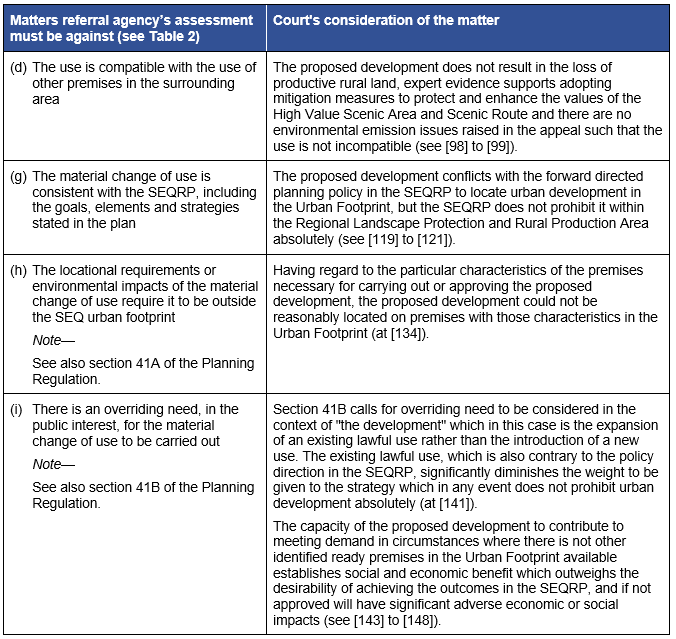
In arriving at its conclusion in respect of matter (i) above, the Court held that "overriding need" does not require "pressing or overwhelming need" and involves "a need for one outcome overriding a competing outcome would occur where the former was more important, in the sense of achieving an advantageous outcome" (see [139] and [140]). The "competing outcome" in this case is the desirability of achieving the policy in the SEQRP to consolidate urban development in the Urban Footprint, which the Court held in this case was significantly diminished by the existing lawful use.
Planning Scheme assessment
The Council identified a number of noncompliances with the Planning Scheme. Of particular relevance were those directed to limiting urban uses within the Rural Zone (see [150] to [156]).
The Court found noncompliance with the Rural Zone Code in that, similar to the SEQRP, it seeks to consolidate urban development in other zones and establishes urban development as an inconsistent use not intended in the Rural Zone (at [168]).
The Court held that there is a lack of conflict with other aspects of the relevant assessment benchmarks, including in the Strategic Framework, and that the outcomes sought to be achieved do not have the effect of prohibiting urban uses in the Rural Zone absolutely. The Court was satisfied that there will be service to the rural community if the proposed development is approved and that there is no potential rural use of the premises for the foreseeable future (at [170]).
Court's discretion
Whilst ordinarily noncompliance with the forward planning strategy in the SEQRP and Planning Scheme will be afforded significant weight, the Court was satisfied the circumstances of this case result in the weight to be given to that noncompliance being considerably diminished (at [176]). Significant to the Court's finding is the existing lawful use of the premises which is inconsistent with the planning strategy for the same reasons as the proposed development and that the proposed development application will not introduce a new use (at [177]).
Further, the weight to be given to noncompliance with the SEQRP is also diminished by the lack of conflict with the matters for referral agency assessment set out in the table above (at [180]).
The Court was satisfied that the public interest is better served by giving an approval. In this regard, the Court considered the lack of broader noncompliance with the applicable planning instruments; the absence of adverse submissions in the development application process; the absence of unacceptable amenity or other impacts; that a conditioned approval will be an efficient use of the premises, enhance the visual effects and scenic amenity values, and improve access and ecological values; and there is a planning need (at [185]).
Conclusion
The Court allowed the appeal and set aside the Council's decision to replace it with a development approval subject to conditions (at [186]).
Key points
The following key principles from the Court's decision are significant and important:
- Whilst an applicant ought not derive an advantage by making arguments in proceedings that rely on an existing unlawful use, the Court may have regard to factual matters related to the unlawful use such as amenity and environmental impacts if that is the best information available about the merits of the application (at [46])
- Whilst it is desirable not to approve a proposal that does not comply with a forward planning policy or strategy in an applicable planning instrument, noncompliance does not preclude the Court from giving an approval and will depend on the facts and circumstances of each case (at [53(a)]). An existing lawful use of premises may be given significant weight where a development application does not seek to introduce a new use but, for example, seeks to materially increase the scale and intensity of the existing use (at [177]).
- The statutory assessment does not require a rigid application of the provisions of a planning scheme or a starting point that the provisions can not be overcome (at [53(b)]).
- The Court is not bound to accept the views of an expert witness especially where those views are not appropriately or adequately explained (at [77]).
- Whilst a local government as the assessment manager is bound by the position of a referral agency, the Court is not so bound (at [171]).
- The avoidance of the entrenchment of non-conforming uses is not an inflexible rule but planning strategy in relevant planning instruments is not to be lightly put aside (at [173]).
.png?language=en-AU)
.png?language=en-AU)