The 30% minimum tax on discretionary trusts: What the exposure draft actually does, and why the election is not the easy answer
By Jon Meadmore and Amy Liu
Treasury released the first tranche of exposure draft legislation for the 30% minimum tax on discretionary trusts on 3 September 2026. The regime is proposed to commence on 1 July 2028 Consultation closed on 18 September 2026 and the Government is reported to want the legislation passed in 2026.
In brief: The regime in outline
The measure was announced on 12 May 2026 in the 2026–27 Budget. Under the exposure draft legislation, from 1 July 2028:
- Minimum 30% tax: A discretionary trust's net income is taxed at a minimum rate of 30% at the trustee level. Franking credits on dividends or distributions included in the trust's minimum tax income must be applied by the trustee against that tax, with any excess refunded to the trustee. As a result, those credits no longer flow indirectly to beneficiaries. Instead, non-corporate beneficiaries presently entitled to a share of the trust's net income receive a non-refundable tax offset equal to 30% of their share of minimum tax income. Beneficiaries on marginal rates below 30% can currently obtain a refund of excess franking credits, but under the new regime they may be disadvantaged and their position should be modelled. Corporate beneficiaries receive neither the offset nor the franking credit and remain assessable on their share. As a result, the traditional bucket company arrangement becomes significantly less tax effective.
- Exclude trusts: Fixed trusts, special disability trusts, deceased estates, complying superannuation entities and trusts prescribed by legislative instrument. Managed investment trusts, attribution MITs, other widely held trusts, bare trusts and employee share trusts are not intended to be caught.
- Excluded income: Primary production income, certain income of vulnerable minors, qualifying distributions to charities, DGRs and (up to a cap still to be set) other exempt entities, income subject to non-resident withholding tax and income of genuine testamentary trusts.
- New definition of fixed trust: Treasury has substituted an expanded, codified definition of fixed trust (new s 272-65 of Schedule 2F), which applies across the income tax law. A trust is a fixed trust if its beneficiaries have fixed entitlements to all of its income and capital, or if there are no material discretionary elements affecting their rights or entitlements. Matters suggesting there are no such elements include:
- beneficiaries have clearly defined, specific and enforceable rights to all of the income and capital, or in relation to the governance of the trust, subject only to non-discretionary rules;
- powers to vary rights cannot be exercised to significantly vary existing rights or significantly affect the value of existing interests; and
- any power to vary the deed can only be exercised with the consent of all beneficiaries, or in a way that cannot adversely affect them.
That shifts the question from "is my trust fixed under Schedule 2F?" to "does my deed contain a material discretionary element?". The draft does not define "material", "significantly" or "governance", and the listed factors are not exhaustive. For groups running multi-tiered structures, the analysis has to be done at every level, and where real doubt remains a private ruling may be worth seeking.
Trustees therefore have three options, each explained below:
- do nothing and pay the 30% minimum tax as the current position;
- make an excluded election trust (EET) election; or
- restructure under the rollover into an eligible entity.
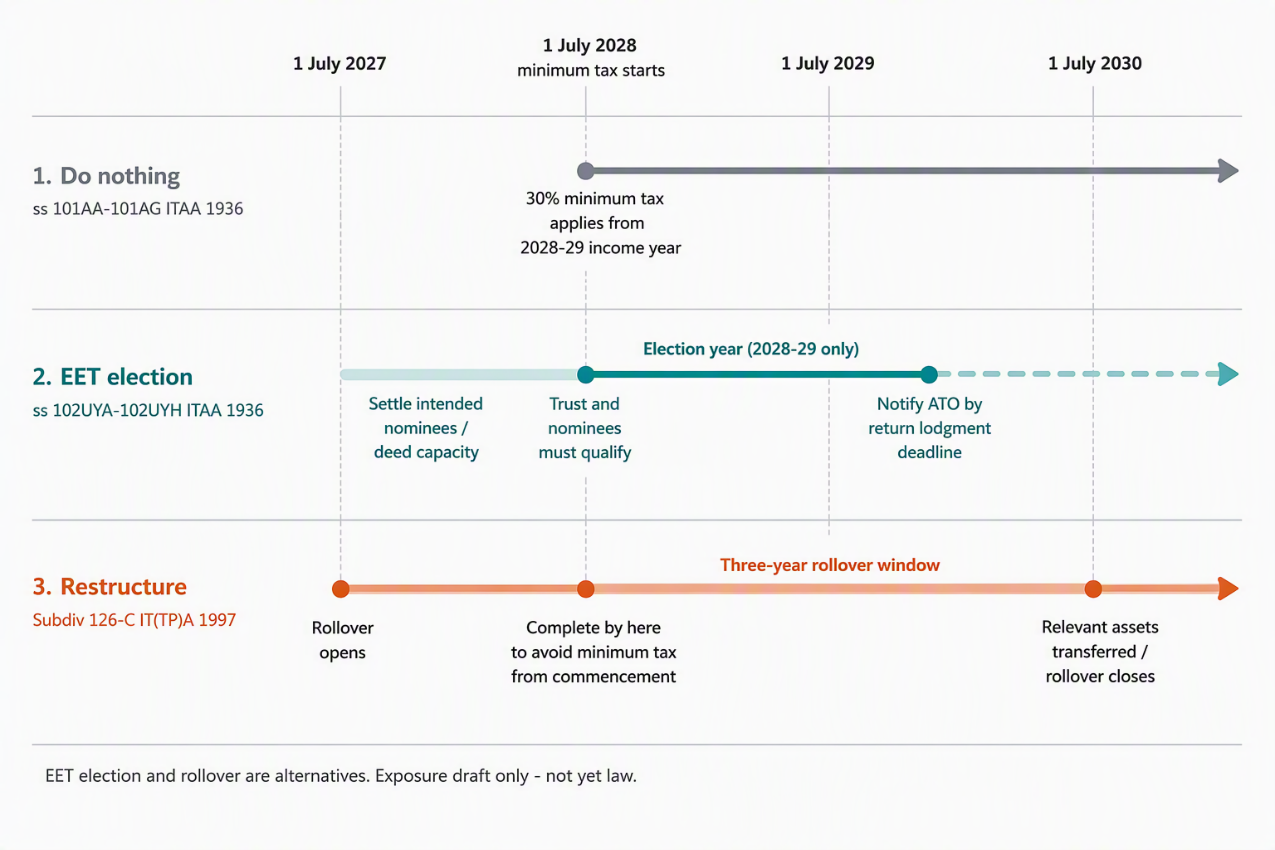
* For illustrative purposes only. Based on exposure draft legislation; proposed measures are not yet law and are subject to change.
Alternative 1: Excluded election trust
A trust in existence on 1 July 2028 can nominate beneficiaries and fix their entitlements to income and capital. It can falls outside the minimum tax without transferring any assets, and where the existing deed already accommodates proposed nominees without restructuring the trust. The price is flexibility, because the draft imposes tight conditions:
- The election can be made only once, in the 2028–29 income year and cannot be made if the trustee has chosen the rollover.
- Each nominated beneficiary must take the same share of both income and capital, and the shares must total 100%. The nominees can be individuals, trusts, exempt entities and eligible companies, provided they were capable of benefiting under the deed as it stood on 1 July 2028. An eligible company is one with no material discretionary elements affecting its members' interests.
- Once made, nominations are generally irrevocable. Changes are permitted only on the death of a nominee, whose share can pass only to individuals who are beneficiaries of the deceased's estate, or on a relationship breakdown between two nominees.
- The election can be revoked deliberately by the trustee. It is also revoked automatically by a distribution that does not follow the nomination, the vesting or winding up of a nominated trust, or a nominated company being wound up or having a share transferred other than on death or relationship breakdown.
- Revocation is costly. In the year of revocation, every beneficiary made presently entitled is treated as never having been so. The trustee is taxed on all of the trust's net income at the top marginal, and the trust falls into the minimum tax from the following year. A revoked election can never be remade. The election therefore imports a standing governance obligation and needs to be monitored, alongside any family trust or interposed entity election.
The Treasurer has indicated that the election is not expected to attract stamp duty, but no State or Territory has confirmed that position. In several jurisdictions, duty legislation applies to changes in beneficial or equitable interests in dutiable property rather than the signing of documents. However, the election operates without amending the trust deed and reasonably arguable that it does not itself change beneficial ownership. Until the States publish their position, clients should not assume the election will be duty-free.
Alternative 2: Rollover into an eligible entity
For groups that find the election too restrictive, the alternative is to restructure out of the discretionary trust altogether. The rollover runs from 1 July 2027 to 30 June 2030. It allows assets to move into a company, fixed trust or other eligible entity without immediate income tax consequences. The relief comes with conditions of its own:
- One transferee. All relevant assets must go to a single entity, which cannot be an exempt entity, a complying superannuation entity or another minimum tax trust.
- All relevant assets. The whole asset pool must be transferred by 30 June 2030. The exceptions are assets that cannot be transferred, primary production assets, assets needed to meet trust liabilities or winding-up costs, and assets that cost $1,000 or less.
- No discretionary transferee. The transferee must have no material discretionary elements until the end of the fourth income year after the final transfer, or the relief can be clawed back.
- Continuity. Where a family trust election is in force, every individual with an interest in the transferee must have been a beneficiary and a member of the family group. For other trusts, the test is left to a ministerial instrument, and if none is made the rollover is not available to them.
The rollover defers the relevant income tax consequences rather than permanently exempting the transferred asset from tax. Unlike the election, the rollover gives no relief from State or Territory duty. A restructure may also be commercially difficult where licences, contracts or finance cannot readily be moved.
Implications other than tax
Whichever option is chosen, the legal consequences beyond tax are less visible and should also be modelled. They weigh most heavily on the election:
- Asset protection. Fixing beneficiaries' entitlements may materially alter the asset-protection characteristics of the trust, particularly where a beneficiary has an enforceable entitlement to income or capital. Creditor and insolvency consequences should therefore be considered before an EET election is made.
- Succession. Fixed entitlements remove the flexibility to respond to changes in the family or business. Family members born after 2028 can be added only through a deceased nominee's share. Shares in a nominated company cannot be passed on during the founder's lifetime without revoking the election.
- Family law. Fixed entitlements may affect how a beneficiary's interest is characterised in family-law proceedings and should be separately considered.
- Testamentary trusts. The exclusion covers only income from estate property, so property added after 7.30 pm on 12 May 2026 is caught. For testamentary trusts established from 1 July 2028, the income must go to individuals or exempt entities.
- Deed capacity. Nominees must be objects under the deed as at 1 July 2028. Any widening of the class of beneficiaries, and any nominee company or trust, must be in place before then. Any amendment must be within power and should be checked for resettlement.
- Financing. A deed amendment or restructure may need financier consent or trigger a review event. Clients should check facility agreements early, particularly in geared property and infrastructure structures.
How we can help
Our Corporate & Commercial team can assist with trust structuring, trust deed reviews and variations, State duty implications and the succession and asset protection considerations arising from the proposed regime. We are also closely monitoring future legislative tranches and any related ministerial instruments to help clients understand and prepare for the changes.
Clients should test each trust at every level of the group and model the three options: the election, a restructure under the rollover or accepting the minimum tax. Where restructuring is preferred, the trust's family trust election status should be reviewed and any transfers ideally completed during the 2027-28 income year. If electing, settle the beneficiaries and any nominee companies before 1 July 2028 and put distribution governance in place. In either case, review succession, asset protection and family law exposure, wills that set up testamentary trusts, and financing documents.