Compulsory acquisition and rural land: What agricultural landowners and businesses need to know
By Todd Neal and Anthony Landro
Compulsory acquisition of rural land will often raise complex issues for ongoing land use and long term asset values. Landowners and agribusinesses should identify operational impacts early on, and understand the available heads of compensation including what is needed to support a claim. Body.
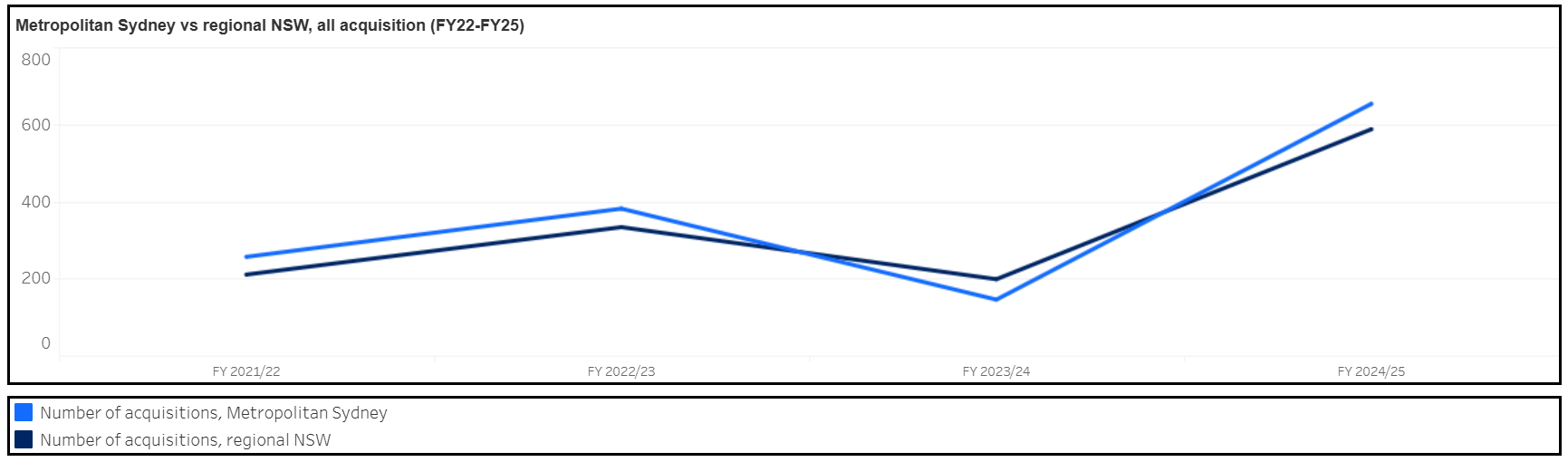
Compulsory acquisition of land is confronting for any landowner, but it often has unique and amplified consequences for agricultural and rural businesses. According to the Australian Department of Agriculture, Fisheries and Forestry, Australian farms comprise about 57% of Australia's landmass, meaning that as new public infrastructure demands arise, the prospect of a compulsory acquisition impacting a farm will increase. It is something that needs to be carefully considered by those with an interest in land within this sector. As the recent NSW Property Acquisition Data shows, rural acquisitions in the last four years have broadly equalled the number of urban acquisitions:
With the range of linear infrastructure projects being pursued across rural areas including not just roads, but infrastructure such as transmission lines to support the rollout of more renewable energy, or rail infrastructure for the Inland Rail (which has recently been suspended), the effects of a compulsory acquisition and the development of recent case law on the heads of compensation available under the Land Acquisition (Just Terms Compensation) Act 1991 (Just Terms Act) will be increasingly felt in rural communities.
Unlike residential land, rural properties frequently involve interdependent operations such as livestock, cropping, water access, improvements and long established business practices. Farms often have added complexity involving generational ties to land but fused with modern corporate structures and trusts and one of the focal points in acquisition law is valuing the actual "interest" in the land that is being taken or diminished by the compulsory acquisition. The 35-year-old Act was drafted with typical owner-occupier homes in mind and the provisions of the Act are not tailored for the types of ownership structures often seen in rural properties.
The concept of "market value" is paramount under the Act. Theoretically, "market value" compensates the interest holder with the value of that person's interest, which for the registered proprietor, might translate in money to purchase the equivalent interest elsewhere. But often, the figure for "market value" can be seen as inadequate when the unique attributes of the land mean the operations are unable to be readily replaced elsewhere. It is also problematic when only a part of land is taken, as it might not be possible to replace the acquired land by purchasing from an adjoining owner - as there is nothing compelling the adjoining owner to make such land available. This then pushes the affected landowner to look elsewhere for "replacement" land. In many cases, it is not feasible to do so.
Acquiring authorities to varying degrees appreciate this but are constrained by the pressure of audits and ensuring compensation fits within the heads of compensation.
This article outlines key issues rural landowners and agribusiness operators should understand when their land is subject to compulsory acquisition.
Compulsory acquisition is not just about land value
While compensation is often narrowly framed through the prism of the “market value of the land taken,” for rural owners, this is only part of the picture.
Agricultural land acquisitions in our experience commonly involve ongoing cropping or grazing enterprises that are impacted. The properties have specialised, bespoke and costly infrastructure being impacted (yards, sheds, silos, irrigation and fencing), as well as impacts to water access, transport routes or neighbouring land that arise. Resumptions involving agricultural land involve a need to understand the land's productive capacity where metrics such as dry sheep equivalent (DSE) become relevant. Climate related risks such as flood, fire and erosion, as well as biosecurity issues caused during construction of the infrastructure need to be factored in, which is complex and costly to understand. There is a need to look at the viability, scale or profitability of the agricultural business being diminished as well as any impairment of operational efficiencies built up over many years.
These matters can be hard to articulate but are incredibly important and may be material to a claim.
These types of issues arise even where only part of a property is acquired, or even if the acquisition involved is just an easement or licence created through the compulsory acquisition process over part of the land, such as for overhead transmission lines or access tracks.
Impacts such as these are legally relevant and should not be overlooked by the valuers and lawyers navigating the resumption process for both acquiring authorities and landowners.
It is also critical to understand the ownership of the land and to ensure the owners with an interest in the land are properly accounted for, as each owner of an interest in the land has a separate claimable interest under the Just Terms Act. This might involve for example the freehold owner and separate companies that lease or licence all or part of the land.
Special value may apply to rural land
In our experience, a veil of mysticism shrouds the head of special value and so we wish to start our description of the heads of compensation with this.
Special value is rarely accepted by acquiring authorities and the Valuer General and there have been limited cases that have fully explored the concept. Despite a number of recent NSW Land and Environment Court cases run by self-represented litigants where special value has been claimed but read down, when paired back to the statutory definition, the concept of special value appears to us to require more considered application in rural acquisitions.
Each State and Territory makes provision for a special value head of compensation, but in NSW section 57 of the Just Terms Act defines special value in the following way:
In this Act -
special value of land means the financial value of any advantage, in addition to market value, to the person entitled to compensation which is incidental to the person’s use of the land.
The Commonwealth Land Acquisition Act 1989 also includes a head for special value at section 55(2)(a)(ii):
(ii) the value, on the day of the acquisition, of any financial advantage, additional to market value, to the person incidental to the person's ownership of the interest.
In some circumstances and applying the definition in the statute, rural land may have a special value to the owner beyond its general market value. We see this as potentially arising where:
- the occupation of the land has a particular advantage in addition to its market value, such as improvements that enable a business model that cannot easily be replicated elsewhere, or its configuration and location together with its improvements create efficiencies unique to the owner;
- there is locational goodwill that cannot be replicated elsewhere;
- the advantages are not part of the market value of the property;
- the improvements are a financial advantage because they are quantifiable;
- the "financial advantage" is due to the specific owner operating in that location (not some other person); and
- the financial advantage is incidental to the owner's use of the land given the nature of the business being conducted.
The use of bespoke stockyards and paddocks may add little to the price a hypothetical buyer would pay but can be pivotal to the owner’s business and if losing those improvements forces the business to incur costs, inefficiencies or operational changes, we see that fulfilling some of the indicia to the statutory definition of special value.
Special value does not compensate emotional attachment and cannot be used to duplicate market value.
Our view is that a return to a focus on the question posed by the statute is needed:
Is there a financial advantage, beyond market value, which arises from how this land is used by this owner?
Severance and injurious affection are often central issues
Partial acquisitions are common in infrastructure projects affecting rural areas, and these types of acquisitions can give rise to:
- severance: where the remaining land is reduced in value because part has been taken; and
- injurious affection: where the use or enjoyment of retained land is adversely affected by the public purpose underlying the acquisition.
For agricultural land, we have seen recent claims compensated under the above for matters like:
- disruption to farm layout or access;
- reduced carrying capacity;
- interference with water, drainage or irrigation systems;
- visual and auditory impairment to the farm homestead and cottages from the public purpose (as well as stigma);
- increased management costs or inefficiencies; and
- reduced mortgageability and increased insurance premiums from environmental risk.
These impacts need to be assessed holistically, with reference to how the farm or business actually operates.
Disturbance goes beyond moving costs
Before 2020, claims for many capital works items that a farm might need to carry out as a result of the compulsory acquisition of land would be dealt with de rigeur by both the Valuer General and the Land and Environment Court on appeal, under either compensation for “relocation” under s 59(1)(c) or as “business loss” under s 59(1)(f). Claims under this head historically would include:
- new farm infrastructure needed as a natural consequence of the acquisition (e.g. stockyards, shelters, irrigation infrastructure, specialist fencing or paddock layouts);
- creating new internal roads or relocating farm buildings; and
- loss of profits for business disruption.
Historically, the disturbance head was described as a “catch all” provision.
Under this historical approach, it is important to remember that the special value head explained above was said not to arise in these situations because of the availability of a claim under the disturbance head.
However, the range of disturbance losses has been substantially narrowed in recent years through various NSW Court of Appeal decisions, even though practically, acquiring authorities continue to compensate landowners under this head for the items mentioned above.
Timing and process matter
In our experience, early identification and documentation of the perceived impacts remains essential in order to enable those preparing the claim to consider how and whether these impacts can be framed and compensated under the heads of compensation in the Act. Some of these matters are fundamental to the profitability of the farm and if not carefully considered and planned as part of the preparation of a claim for compensation, these types of issues may be left partially or fully uncompensated.
Compulsory acquisition often follows a long statutory process, but how and when issues are raised can materially affect outcomes.
We see the best results for dispossessed owners who:
- engage early with valuation and lawyers familiar with rural land acquisitions and who can brief the right experts to support a claim;
- ensure their team of experts understand how the land is used in practice so this can be communicated to the acquiring authority;
- request information from the acquiring authority on the modelling of the project's impacts;
- respond carefully to requests for information since that information will not necessarily be without prejudice if the matter needs to be litigated; and
- are able to provide evidence of the impacts.
Careful preparation at the front-end is critical to navigating the acquisition process effectively. Although there are beneficial cost rules in Class 3 of the NSW Land and Environment Court for dispossessed landowners, it is preferable to avoid litigation where possible.
Conclusion
Compulsory acquisition of rural land requires a practical assessment of the interests in land and how the property and business operate. Market value may be only one part of the claim. Depending on the circumstances, special value, severance, injurious affection and disturbance may also be relevant.
Early advice, careful documentation and appropriately briefed legal experts can help landowners identify compensable impacts, present the evidence clearly and reduce the risk that material losses are overlooked and left uncompensated due to a lack of careful planning and preparation.
For further guidance on compulsory acquisition matters, please contact our Planning, Government, Infrastructure and Environment team.