Child safety compliance under the new national law: A legal perspective for ECEC providers
By Leanne Dearlove, Megan Kavanagh and Max Spork
Australia’s early childhood education sector faces major child safety reforms from February 2026, including a national worker register, mandatory training, new conduct offences, stricter device‑use rules and significantly higher penalties. Childcare providers must ensure swift compliance with the amended National Law and expanded enforcement powers
Disclaimer: This article contains details about sexual assault/abuse which may be upsetting for some readers. Reader discretion is advised.
In brief
Australia has introduced the most significant overhaul to early childhood regulation since the National Quality Framework began, with major child safety reforms commencing from 27 February 2026. The changes respond to systemic failures exposed by recent childcare incident and introduce a new national workforce register, additional training duties, new conduct offences and significantly tougher penalties. Providers will need to act quickly to ensure their governance, workforce and compliance systems meet the new obligations.
Although the National Early Childhood Worker Register went live on 27 February 2026, requiring employers to upload details of existing staff before 27 March 2026, there is no indication yet of the rate of compliance.
To ensure that your organisation is compliant, this article outlines the steps that must be taken. Regulators are expected to be following up on providers in the coming weeks.
Overview
Across Australia, the regulatory environment for early childhood education and care is undergoing significant reform. A series of childcare incidents has exposed systemic vulnerabilities, placing the sector under a spotlight that grows brighter by the day. Increased media reporting underscores the urgency. In Queensland alone, one person is arrested every 2.3 days for possessing or creating child sexual abuse material (see Luke Twyford, Principal Commissioner of the Queensland Family and Child Commission, ABC Radio National Breakfast (24 February 2026)).
Community expectations of safety and professionalism are understandably high. Regulators are poised to enforce the expectations as defined in expanding regulatory duties, following the commencement of wide‑ranging amendments to the National Law on 27 February 2026 under the Early Childhood Legislation Amendment (Child Safety) Bill 2025 and specific laws in each state and territory.
While recent criminal cases highlight the need for reform, it also highlights that providers are under pressure in many respects, including shortage of quality trained staff, high turnover in the sector, increasing costs and the growing demand for services. At times, pressure to make quick hiring decisions can result in compromised hiring, which may not comply with child safe practices including appropriate screening, supervision and onboarding practices. The pace of ongoing reforms puts further pressure on providers to keep up.
Failures in information sharing, particularly in cases like that of Ashley Paul Griffith, highlight the reason for structural reform. Griffith was dismissed from five different organisations, he’d been reported to police and as a result regulatory authorities had assessed his conduct and found there were six formal complaints to childcare operators about his conduct. Rather than directly address his conduct, the problem was passed on, creating higher risk for children. The focus on self‑reporting contributed to the challenge.
Taking the lesson from this example, the cornerstone of the reforms now in effect is the establishment of the National Early Childhood Worker Register, designed to give regulators national visibility of who is working in which services and where. The reforms also strengthen training duties, create new conduct offences, impose strict device‑use requirements and significantly expand the enforcement framework, including major increases to applicable penalties for non‑compliance.
Childcare services across all jurisdictions will need to review and update their compliance systems to ensure they meet these new requirements.
What does this mean for childcare providers?
From 27 February 2026:
-
Approved providers were required to enter workforce information into the register by 27 March 2026 and update it within 14 days of new workers starting or any change to information.
-
All staff must complete child protection and child safety training by 27 August 2026 and within 14 days for new staff starting after 14 August 2026.
-
‘Inappropriate conduct’, defined as conduct a reasonable person would consider to be inappropriate in an education and care service, is now recognised as an offence. Relevant circumstances will include accepted care practice, the child’s age and stage of development, whether the conduct is likely to cause harm (emotional, psychological or physical) and whether the conduct is sexual, aggressive or violent.
-
Strict limits on staff use of personal devices, including smartphones, smartwatches and other communication devices, will be enforced. This includes prohibiting the use of personal devices to take photos of children, record video or audio, livestream or store or transmit images, even if a parent consents or it is for internal use or documentation. This restriction does not preclude the use of employer‑owned devices, however the use of such devices must be strictly monitored and audited.
-
Three‑fold increases to penalties and expanded use of penalty infringement notices.
-
Expanded prohibition powers allowing regulators to amend, suspend or cancel provider approval.
NSW has added further guidance to include inappropriate conduct that is direct or indirect, verbal or electronic, including the taking of photographs or video.
National Early Childhood Worker Register
Australia does not yet have a real‑time national database capable of sharing relevant criminal information across borders. The proposed National Continuous Checking Capability (NCCC), part of the joint Federal and State response, is not expected to be operational until 2029. The National Early Childhood Worker Register is intended to address some of the visibility gaps in the meantime.
From 27 February 2026, all National Quality Framework approved providers must provide workforce information to the National Early Childhood Worker Register. This was required to be completed by 27 March 2026 and thereafter within 14 days of a worker being employed, engaged or appointed, or within 14 days of any change to that information (see ACECQA (2026), Communications toolkit: National Early Childhood Worker Register Feb 2026, which outlines commencement of the Register on 27 February 2026 and provider obligations).
Failing to comply may result in penalties and potential changes to the provider’s approval status. The prescribed penalty is $6,600 for an individual and $34,200 for any other case.
Recent amendments also allow the regulator to share the identity of individuals (employed, appointed or engaged) who are subject to prohibition notices or enforceable undertakings with approved providers and recruitment agencies (see sections 272 and 272A of the Education and Care Services National Law).
Training requirements
Australian Centre for Child Protection training
All staff must complete both child protection training and foundation child safety training by 27 August 2026, and all new staff commencing after 14 August 2026 must complete the required training within 14 days of starting.
That training includes topics ranging from understanding child abuse and harm, professional boundaries (including safe physical behaviour and use of devices), cultural safety, identifying and responding to child safety risk and inappropriate conduct, and reporting and policy requirements.
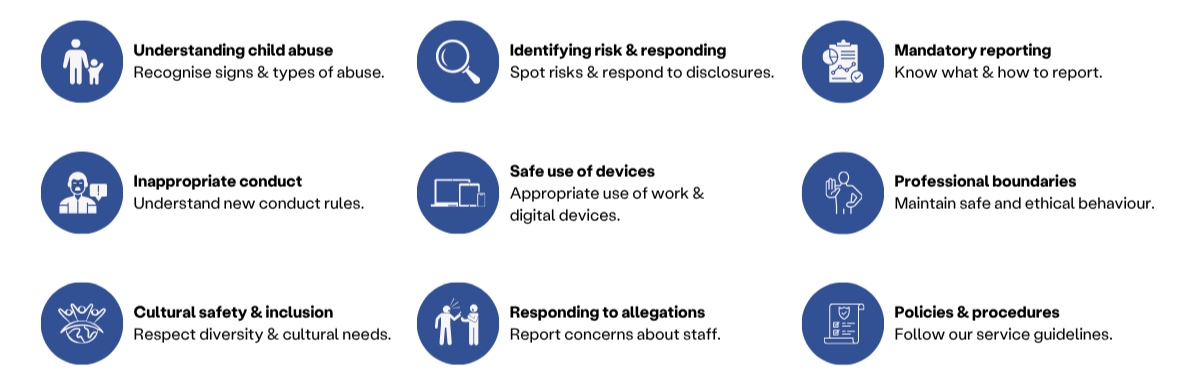
Failure to comply may result in penalties or changes to the provider’s approval status. The penalty amounts are $6,600 for an individual and $34,200 for any other case.
New offences relating to inappropriate conduct
Approved providers and nominated supervisors may be held liable for the conduct of another person, such as staff members, if that person subjects a child in their education and care service to ‘inappropriate conduct’.
Penalties for inappropriate conduct extend to $172,000 under the National Law and $516,600 for large childcare providers in New South Wales.
Service‑supplied devices: Stricter limits on staff use of personal devices have also been introduced. Images of children may only be taken, stored or transmitted on service‑supplied or service‑authorised devices for education and care purposes.
A fine of $6,600 applies to providers, supervisors, staff and volunteers for any breach. Such conduct may also fall within the inappropriate conduct offence.
Different training requirements
Every state and territory now requires structured, evidence based training that equips educators to recognise, respond to and prevent harm. The core modules between the states are similar and include identifying abuse and neglect, understanding the new inappropriate conduct offence, safe use of digital devices, maintaining professional boundaries and mandatory reporting obligations.
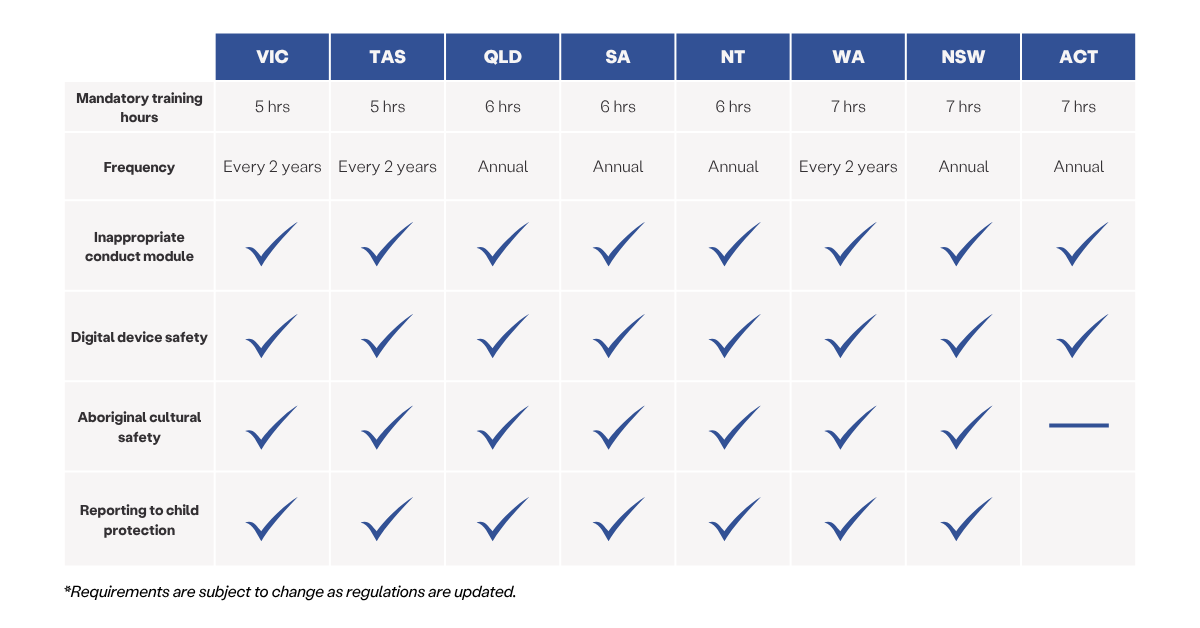
The duration and renewal frequency vary between states.
The inclusion of Aboriginal cultural safety and digital device protocols reflects a move towards holistic child protection, integrating cultural awareness and technology ethics into everyday practice.
Significant increase in pecuniary penalties
All maximum penalties under the National Law have been increased three‑fold.
In New South Wales, the new ‘large childcare provider’ penalty category introduces fines of up to $516,600 for service approval, supervision, protection, staffing and conduct offences, and up to $1,034,100 for core safety and quality offences.
A ‘large childcare provider’ has the same meaning as in the A New Tax System (Family Assistance) (Administration) Act 1999 (Cth).
Prohibition notice powers expanded
Included in the recent amendments are powers for the regulatory authority to amend, suspend or cancel an early education provider’s approval if satisfied that a ‘systemic risk’ exists in relation to the approved provider or a related provider.
-
Power to amend approval (new subsection 23(2A)): The regulatory authority may amend the provider approval, vary conditions or impose new conditions where reasonably necessary to address the systemic risk.
-
Power to suspend approval (new subsection 25(2)): The regulatory authority must be satisfied that a suspension is reasonably necessary to address the systemic risk.
-
Power to cancel approval (new subsection 31(2)): The regulatory authority must be satisfied that cancellation is reasonably necessary to address the systemic risk.
-
Systemic risk: Systemic risk is defined as a risk to the safety, health or wellbeing of a child by an approved service, or a risk of the approved provider contravening a law of the National Quality Framework (see section 5D of the National Law).
Key takeaways
These reforms represent a fundamental shift in how early childhood services are regulated, monitored, engage with staff and held accountable. Heightened scrutiny, a national workforce visibility regime, mandatory child‑safety training, new conduct‑based offences, strict limits on personal device use and a steep increase in penalties for non‑compliance provide a great opportunity to better ensure safety and oversight but also present a challenge for management and governance structures.
The real test will be ensuring management readiness.
Where compliance is not optional, providers must ensure all staff complete approved training, maintain accurate workforce records and implement written policies on conduct, supervision and technology use. Regulators will expect proof of compliance through training records, policy updates and incident reporting procedures during assessment and rating. Providers need to know that their individual managers are equipped to manage that task.
Services should have already reviewed their screening, onboarding, training, supervision, reporting and governance processes to ensure they align with the amended National Law and the expanded enforcement powers now in effect. Training packages should be prepared in line with the core modules.
Our practice assists providers in meeting the amended National Law through practical compliance support, including policy reviews, staff training and document processes, enabling services to remain focused on quality care while ensuring their governance frameworks meet regulatory requirements. For assistance, please contact Megan Kavanagh, Leanne Dearlove or Max Spork from our Employment & Safety Team.

.jpeg?language=en-AU)